Israeli settler attacks escalate in occupied West Bank as mosques set ablaze and death toll rises
26/07/2026
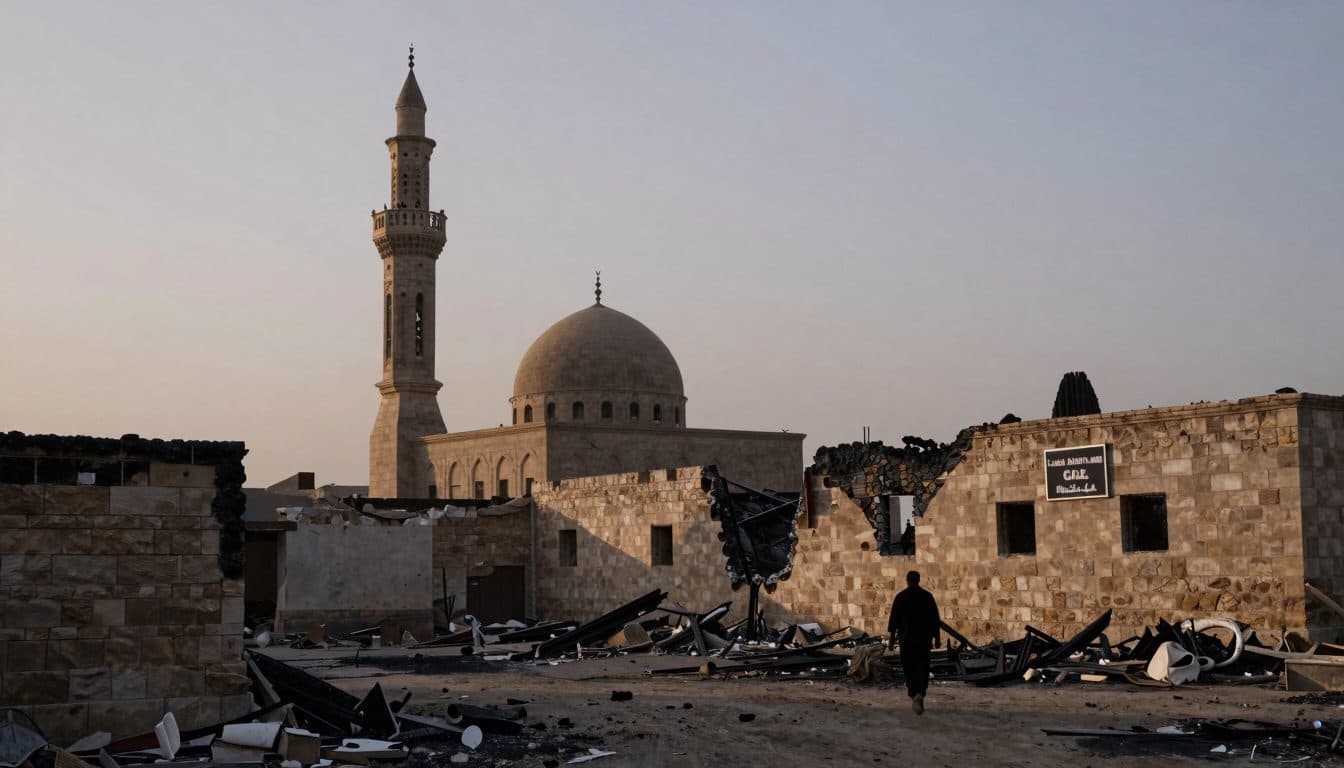
AI-generated image (z-image via Kie.ai)
Summary
Settler attacks on Palestinian villages in the occupied West Bank escalated sharply this week, with residents reporting arson attacks on mosques and Hebrew graffiti referencing recent Israeli deaths. The Israeli military condemned the violence, while security analysts warned of a drift toward lawlessness more than two years into the war in Gaza.
Israeli settlers carried out arson attacks on Palestinian villages and mosques in the occupied West Bank over the weekend, prompting condemnation from the Israeli military and warnings of widening lawlessness.
Settler attacks on Palestinian villages in the occupied West Bank escalated over the weekend, with residents and local officials reporting coordinated arson, stone-throwing clashes and the spray-painting of Hebrew graffiti on religious sites. The wave of violence, which Palestinian representatives describe as the worst flare-up in months, comes amid growing international concern over the breakdown of order in territory Israel occupied in 1967.
In one of the most serious incidents, residents told Reuters that roughly 20 settlers entered a Palestinian village, triggering clashes with villagers that left buildings damaged. Wadi, a resident, said: "Das Dorf ist seit 2011 wiederholt angegriffen worden." The Israel Defense Forces said troops were dispatched to the area and that dozens of "wanted suspects" had been detained in operations carried out in the aftermath of the attacks. The army added in a midday statement that it condemned "solche Vorfälle, einschließlich der Beschädigung religiöser Stätten, aufs Schärfste."
Attaques coordonnées et réponse militaire
In a separate episode near the village of Kur, southeast of the city of Tulkarm, Palestinian representatives said settlers attempted to burn down a mosque. Hebrew slogans were sprayed on its outer wall, including the phrase "Jüdisches Blut ist nicht gratis" and the words "Benayahus Rache" — a reference to Benayahu Mellet, identified by Israeli media as one of two Israeli fatalities from a Friday shooting near Tel Aviv. The Hebrew phrase "Jüdische Rache" was also sprayed on buildings in the village that was first attacked this weekend, residents said.
Palestinian farmer Dschijusi, who lives in the village that suffered the first attack, told reporters: "Dies ist der erste Angriff, den unser Dorf erlebt hat," underscoring how a community that had so far been spared has now been drawn into the cycle of violence. Another resident added: "Diese Angriffe haben seit dem Krieg zugenommen," echoing accounts gathered by rights groups over recent months.
Bilan humain toujours plus lourd en Cisjordanie
The violence adds to a steadily rising toll in the West Bank. According to Palestinian figures, more than 21 Palestinians have been killed in settler-related incidents since the start of the year. Independent monitoring organizations have logged thousands of additional incidents involving assaults, property destruction and crop burning since the Hamas-led attack on Israel in October 2023 triggered the war in Gaza.
Israel launched that war after the Hamas attack of 7 October 2023, which Israel says killed around 1,200 people. Since then, Israeli strikes on Gaza, much of which has been reduced to rubble, have killed more than 73,000 people according to Palestinian authorities, a figure that includes large numbers of women and children. The war has rippled outward into the West Bank, where the presence of the Israeli army has expanded and where settler communities have grown more assertive, residents and diplomats say.
Alertes à la loi du plus fort depuis Israël
Israeli security officials have publicly expressed alarm at the deterioration. Giora Eiland, a former Israel Defense Forces major general, used the word "Anarchie" to describe the situation in parts of the West Bank. His comments, carried in Israeli media, reflect a wider debate inside Israel about whether the government of Benjamin Netanyahu retains effective control over settler elements operating in the territory.
The army's formal statement on the weekend attacks stressed that "Die Sicherheitskräfte verurteilen Vorfälle dieser Art, einschließlich der Beschädigung religiöser Stätten, aufs Schärfste und werden weiterhin entschlossen handeln, um die Sicherheit und die öffentliche Ordnung in dem Gebiet aufrechtzuerhalten." It did not, however, announce any specific new measures or a timeline for investigations into the mosque arsons or the spray-painted threats.
Répercussions diplomatiques et regard international
Palestinian officials in Nablus, the largest city in the northern West Bank, said they were coordinating with village councils to document damage and file complaints with Israeli authorities. They also called on international observers and foreign consuls to visit the affected sites, arguing that independent documentation is essential given what they describe as a pattern of impunity for settler attackers.
Rights groups have long argued that the legal framework governing the West Bank makes accountability rare. Palestinians who file complaints in Israeli courts frequently see cases closed without charge, while Israeli settler suspects accused of violence against Palestinians are rarely convicted, according to data tracked by Israeli and international organizations. The latest attacks, critics say, reinforce that pattern.
The attempted mosque burnings carry particular weight in a conflict in which attacks on religious sites — both Muslim and Jewish — have repeatedly inflamed tensions. Palestinian Authority officials called the vandalism a deliberate provocation aimed at deepening communal divides at a moment when Gaza's civilian population faces catastrophic humanitarian conditions and cease-fire negotiations remain stalled.
On the Israeli side, politicians across the political spectrum have condemned the arson attacks, with members of the governing coalition and the opposition alike describing the mosque burnings as criminal acts. The political debate has nonetheless continued over whether the Netanyahu government bears direct responsibility for what critics describe as a permissive environment for settler violence.
Impact local et appels à la responsabilité
Diplomatic observers point out that the weekend's events came during a period of heightened scrutiny of Israel's handling of the occupied territories. Several European governments have in recent months moved to recognize Palestinian statehood or impose sanctions on settler organizations, moves the Israeli government has rejected. The new attacks are likely to sharpen that debate in Brussels, Berlin and other European capitals.
Analysts caution that the picture on the ground remains fluid. The Israeli army said it had detained dozens of suspects and was deploying additional troops to flashpoint areas around Nablus and Tulkarm, but residents reported that armed settlers continued to move through villages late into Saturday night. "Anarchie," Eiland warned, is precisely the condition in which small incidents metastasize into wider confrontations.
The longer arc of the conflict remains grim. With Gaza devastated, cease-fire talks stalled, and settler attacks accelerating in the West Bank, international mediators face an environment in which even localized flare-ups carry the risk of escalation. The mosque arsons of late July are likely to be studied both as a symptom of that broader drift and as a potential trigger for what comes next.
For Palestinians in the affected villages, however, the immediate concern is more basic: reconstruction, security and the hope that this week's violence will not be repeated. As Wadi put it, his village has been attacked repeatedly since 2011. The question, residents say, is whether 2026 will be different.
Questions & Réponses
What happened in the West Bank in late July 2026?
Settlers attacked Palestinian villages, attempted to burn mosques near Tulkarm and sprayed Hebrew graffiti including the phrase "Jüdische Rache," while the Israeli army said it had detained dozens of suspects and condemned the violence.
Who is Giora Eiland and why did he speak of 'anarchy'?
Eiland is a former Israel Defense Forces major general who used the word "Anarchie" to describe the deteriorating security situation in parts of the West Bank, reflecting concerns voiced inside Israel about control over settler violence.
How does this fit into the broader war that began in October 2023?
The settler attacks are part of a documented surge in West Bank violence since the Israel–Hamas war began in October 2023, which followed a Hamas-led attack on Israel and has since killed more than 73,000 people in Gaza according to Palestinian authorities.
West Bank settler violence: mosques burned, July 2026 | actualites360